Urban EV Showdown: Mazda MX-30 vs. Honda e
The market for electric cars is growing faster than ever, although two models have managed to establish a significant market among city dwellers: the Mazda MX-30 BEV Prime-Line and the Honda e.Those small electric cars have gotten under the skin of drivers who want style, great efficiency, and a high-quality urban driving experience. Is it luck or just an inherent understanding of what a modern commuter really needs, and the answer lies in sensational sales numbers and a strong foothold on the roads of the UK? These two seem surprisingly good for very dissimilar reasons, giving the taste of a little philosophy in electric mobility , although “taste” is too light a word. In this in-depth Mazda MX-30 BEV Prime-Line review, we’re matching it up bolter against bolter *cough* side by side with the Honda e, to see which of these cars manages best by range, performance, and technology. With the MX-30, Mazda is aiming to deliver an attractive and affordable compact SUV, prioritising sustainable materials and driving feel. By contrast, the Honda e is a retro-futuristic city car, packed with tech inside and out, that’s been designed from the ground up to be nippy around town. Each brings something new to the table and adds a twist that challenges more traditional designs for electric vehicles. The contrast between these two Japanese pioneers is fascinating. Mazda applies its Kodo design language and human-centric technology to the electrification space, with the MX-30’s freestyle doors and interior made from cork and recycled textiles serving as proof points. Meanwhile, Honda stuffs the e with the latest and greatest technology, a full-width digital dashboard, and camera-based side mirrors. Now we have the ingredients for an appealing race: Mazda’s driver-appealing value-packed, style-drenched models vs a clash of competing technologies, competing markets and competing designs, and we’ll help you decide which one is the best fit for your daily driving needs.
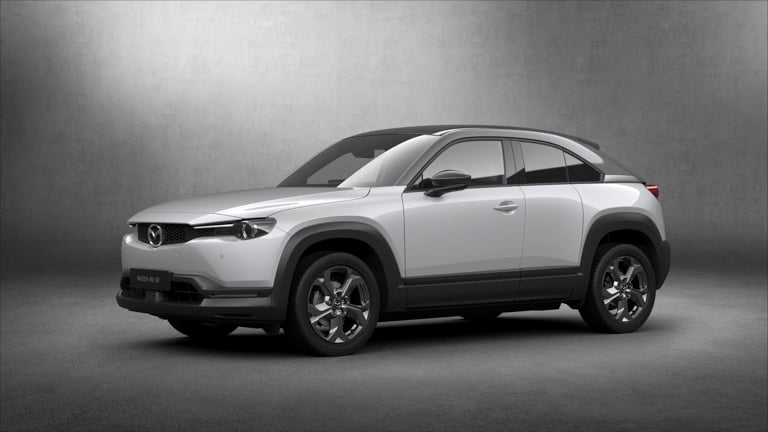
- Distinct Philosophies: The Mazda MX-30 is a pragmatic, sustainable SUV, and the Honda e is a compact city car focused on futuristic tech.
- Driver-Centric vs. Tech-Forward: Focused on the driving experience and human-centric design, Mazda delivers a ride that is grounded and enjoyable.
- Innovative Design Features: Enjoy the convenience and style of the MX-30’s freestyle doors along with the minimalist, green interior.
- Urban Efficiency: Both models are designed for city driving; these cars have more than enough range for your urban commute and the handling skills to weave through tight city streets.
Quick Recap: At a Glance
Before running our Mazda MX-30 BEV Prime-Line review to the ground, here’s a peek at how these two different EVs compare in the most important categories.
- Manufacturer: Two Japanese automotive manufacturers with very different approaches to methodology – Mazda believes in human-centric, Jinba Ittai driving experience; Honda seems to have gone back to the future for urban retro-futuristic technology.
- Year Model: Both vehicles reflect the current-generation EV platform and safety design in the latest expressions of their respective product lines.
- Body Style: The Mazda MX-30 is a compact SUV crossover with a coupé-like roofline, while the Honda e is a 5-door city hatchback.
- Trims/Variants: The Mazda has a clear ranking system in place with the Prime-Line, Exclusive-Line and Makoto; the Honda has just the one base model and the stronger ‘Advance’ trim for simplicity.
- Interior and Exterior Designs: Mazda designs its minimalist, open cabin with doors that fly open, utilising cork and recycled textiles; Honda’s lounge-style cabin is centred around a wall-to-wall digital dash screen pod.
- Performance and Driving Experience: Mazda G-Vectoring Control Plus was designed to enhance the natural driving feel for smoother cornering; Honda uses a rear-wheel-drive architecture to help achieve an extremely tight turning circle and agile city manoeuvring.
- Powertrains: Both cars use modest battery packs (35.5 kWh for Mazda, 35.5 kWh for Honda) meant for “right-sizing” rather than overweighting and tailored primarily for city and suburban use.
- Innovations & Features: Among the main differentiators are the floating console and sustainable materials of the Mazda MX-30 vs the Side Camera Mirror System that replaces traditional wing mirrors on the Honda e.
- Comparison: Classic SUV practicality provides the basis for driving enjoyment (Mazda), which is challenged by high-tech connectivity combined with retro styling (Honda).
- Price Range: The Mazda MX-30 provides a more affordable entry-levelling it the more budget-friendly option, while the Honda e is priced at a premium due to its unique technology and niche design.
Key Takeaways
- Distinct Characters: Get a grounded, natural driving experience with the Mazda, or opt for the Honda if you live a digital-first city lifestyle.
- Urban Focused: The two vehicles curtail battery size to reduce weight and environmental impact, albeit suitable for daily commuting, not cross-country touring.
- Design Led: Neither car is a bland appliance; both make strong, individual design statements in what is a very crowded market.
Overview & Design Inspirations: A Tale of Two Philosophies
As they say, it goes beyond the buff sheets and carves out the spirit of these cars; we get two very distinct versions of the modern electric car. Mazda and Honda have dismissed the notion that an EV needs to look like a boring box. Instead, they prioritised intensely individual design languages that could conjure moods and stoke conversation.
In the case of the MX-30, a courageous advance in its acclaimed ‘Kodo: Soul of Motion’ design philosophy, the new design is radical for Mazda. The designers based their work on the idea of “Human Modern,” removing everything unnecessary to end up with a design that is simple, solid, grounded and natural. Approach right-sizing. The Mazda view is that “minute masterpieces” is a better way to describe cars in this segment, the mini that just got a little bigger. They say a smaller, lighter battery (35.5 kWh) also curtails the all-important lifecycle CO2 emissions – production to disposal, making it one of the genuinely environmentally responsible choices. The engineers based their work on the idea that the car should feel like a natural extension of the driver, not some kind of gadget. The inclusion of heritage cork in the centre console is a tribute to Mazda’s history as a cork producer and enables them to connect their past with a more sustainable future.
Contrastingly, the Honda e is a retro-futuristic minimalism success. Motivated by the original 1970s Honda Civic, it adopts a clean yet warmly inviting design language that Honda calls “the affinity between people and cars.” Even the door handles, which pop out, and the cameras that take the place of traditional wing mirrors are flush and sleek. Honda’s design philosophy was urban living, and nothing else. They pushed the wheels all the way out to the corners of the chassis, more than doubling the interior space and stability, crafting a “lounge-style” cabin that feels significantly wider and more open than what the car’s diminutive footprint would lead you to believe.
Mazda MX-30 BEV Prime-Line Vs Honda e: Similarities and Differences
Both vehicles are Japanese compact EVs intended for urban use, yet their execution could not be more different. This is where the competition heats up in any comprehensive Mazda MX-30 BEV Prime-Line Review.
Perhaps the most notable common trait is that they eschew aggressive looks. Neither vehicle attempts to look like an angry robot; they both opt for clean, smooth surfaces. But whereas the Honda e is all cute and digital, the MX-30 is analogue and sophisticated. A fully digital dashboard stretches across the entire width of the Honda e, placing the driver at the heart of technology. The Mazda MX-30, on the other hand, is all about minimising distraction, with a driving environment that’s calm and focused.
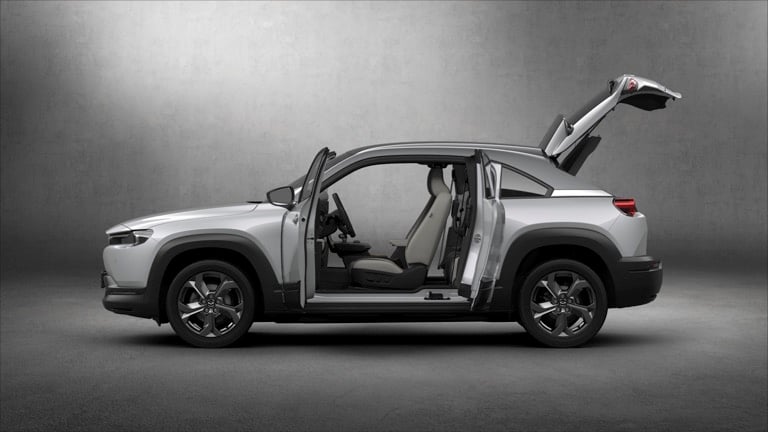
The two also differ in their door arrangements. The Honda e has all the convenience of a conventional four-door arrangement (although the rear handles are concealed), so easy access to the rear. Mazda has “Freestyle” door rear-hinged half doors like the legendary RX-8. This results in a huge pillar-less gap that looks amazing and makes loading items in the back seat easier, though it does mean the front door has to be open before the rear door can be swung open.
Who is buying these cars?
The design decisions are inevitable for target splitting. The Honda e is said to be popular with a young, tech-savvy audience – gamers and gadget fans who see the vehicle as the ultimate mobile device. It also lures style-savvy city dwellers as a statement piece.
The Mazda MX-30 is targeted at a slightly older customer, or the “young professional” who appreciates craftsmanship and driving dynamics rather than how many pixels a screen has. It is a draw for those who want their move to electric driving to feel as natural and solid as stepping into a car rather than a spaceship.
Why are they rivals?
These two models are effectively competing head-on as they target identical customers: buyers in the “second car”/”premium urban commuter” category. Neither were presented as long-range tourers. They both admit you don’t need a giant battery for 90 per cent of your daily driving, which is weighing you down on efficiency. They are competitors because they are competing for the same buyer’s heart, rather than the head, style, brand philosophy and interior ambience, rather than raw range statistics, and that’s what makes the ‘best’ model among these a very subjective opinion.
Key Design & Engineering Takeaways
- Mazda’s “Human Modern” Concept: Feel the warmth of the natural materials and the cabin size that makes the vastness feel human rather than cold and clinical.
- Honda’s Digital Dashboard: Step into a high-tech, connected atmosphere where your digital life seamlessly connects directly with the dashboard.
- MX-30’s Freestyle Doors: Open the door to a wide, pillar-less entry system for easy loading of cargo or children that’s unique in any car park.
- Honda’s Camera Mirror System: Enjoy less aerodynamic drag and rain interference from obtrusive mirrors, replaced by advanced camera technology.
- Sustainable “Right-Sizing”: Feel good about the optimised battery size for reduced lifecycle emissions, without impacting daily use.
Mazda MX-30 vs Honda e: A Full Trim Comparison
Selecting an electric vehicle is often a question of the details available in its trim levels. Mazda and Honda both have separate packages that suit various needs, ranging from basic comforts to state-of-the-art technology and high-end finishes. Knowing the value proposition of each variant is what makes for a truly informed choice. This guide will take you through the Sunshine State Trims in both the Mazda MX-30 and the Honda e to know what you get for your money for both models.
Mazda MX-30 Variants: Prime-Line, Exclusive-Line, and Makoto
The range for the Mazda MX-30 is so clearly defined that you can work your way up through the grades/rim sizes on the tyre sidewall with complete ease. The emphasis is on a high level of standard specification from base model upward, so that no one feels shortchanged. This way of thinking is at the heart of any Mazda MX-30 BEV Prime-Line review.
The Prime-Line is the trailhead to the MX-30 journey. It comes with 18-inch silver metallic alloy wheels, full LED headlights with high-beam assist, and a robust suite of safety features. You get the 8.8-inch central display, a 7-inch digital driver display and the exclusive 7-inch climate control touchscreen inside. It captures the spirit of Mazda in that you have just about all the essentials you need for a drive to be comfortable, engaging and without useless frills.
The Exclusive-Line builds in convenience and luxury. This trim adds keyless entry, heated front seats and an auto-dimming driver’s side mirror. A drastic cosmetic change can be seen by choosing interior designs and a three-tone exterior paint scheme contrast option. For many customers, the Exclusive-Line is the perfect product, offering more features and options at a reasonable price increase.
Makoto is the top model. This is the trimmest-up model, with a high-end 12-speaker Bose audio system, a 360-degree view monitor that makes parking a breeze and a heated steering wheel. It’s the ultimate expression of the MX in technology and in comfort.
Honda e Variants: The Standard Model and the Advance
Honda keeps it simple with two distinctly different versions of the Honda e. Essentially, the decision is now between the basic package and a more powerful, better-equipped model.
The standard Honda e is good enough. It is fitted with the full-width dual-screen dashboard, innovative Side Camera Mirror System and a full range of “Honda SENSING” safety features. It has a 136 PS (100 kW) electric motor. This model is the ultimate urban EV with futuristic tech like no other from the start.
The Honda e Advance is more than an enhanced specification; it’s a performance upgrade. The electric motor has been upgraded to 154 PS (113 kW), so it feels a bit quicker. The Advance also adds the Centre Camera Mirror System (a digital rear-view mirror), premium audio system, heated steering wheel and Honda Parking Pilot that provides automated parking assistance to its standard specification. This is the specification for anyone who wants the full Honda e technology showcase, plus a little extra juice for enthusiastic urban driving.
Variants & Trims Comparison
|
Feature/Trim |
Mazda MX-30 Prime-Line |
Mazda MX-30 Exclusive-Line |
Mazda MX-30 Makoto |
Honda e |
Honda e Advance |
|
Starting Price |
Most Accessible |
Mid-Range |
Premium |
High |
Higher |
|
Powertrain |
145 PS e-Skyactiv |
145 PS e-Skyactiv |
145 PS e-Skyactiv |
136 PS Electric Motor |
154 PS Electric Motor |
|
Wheels |
18-inch Silver Alloy |
18-inch Bright Alloy |
18-inch Bright Alloy |
16-inch Alloy |
17-inch Alloy |
|
Keyless Entry |
No |
Yes |
Yes |
Yes |
Yes |
|
Heated Seats |
No |
Yes |
Yes |
Yes |
Yes |
|
Audio System |
8-Speaker System |
8-Speaker System |
12-Speaker Bose |
6-Speaker System |
8-Speaker Premium |
|
Parking Aids |
Rear Sensors & Camera |
Front & Rear Sensors |
360° View Monitor |
Rear Camera |
Honda Parking Pilot |
|
Side Mirrors |
Standard Electric |
Standard Electric |
Standard Electric |
Camera System |
Camera System |
|
Notable Feature |
Sustainable Cabin |
Optional 3-tone paint |
Bose Sound System |
Full-width Display |
Uprated Power |
Key Takeaways from the Trim Breakdown
- Impressive standard equipment: That doesn’t mean the standard equipment for the base 2022 Mazda MX-30 Prime-Line isn’t impressive, though it is quite generous, and there should be no complaints about value.
- Performance Upgrade: The Advance version of the Honda e provides a real power boost, making the already peppy, responsive city car even livelier.
- Luxury vs. Tech: The posh Mazda MX-30 Makoto emphasises luxury comfort features such as a Bose sound system, while the Honda e Advance places more emphasis on state-of-the-art technology, including automated parking.
- Clear Value Progression: Mazda’s trim levels have a clean, coherent progression of comfort and convenience that lets you fine-tune your budget.
- Streamlined Decision: With Honda’s two-trim approach, the choice is simple. If you want more power and all the optional toys, go with the Advance.
Mazda MX-30 Vs Honda e Spec Sheet Appendix
For the obvious at-a-glance comparison, this tech appendix compiles the most important maker quoted specs of the Mazda MX-30 BEV Prime-Line and the Honda e. It’s a no-frills look at the performance, range and size numbers of these two exciting city EVs. To fully understand these numbers is a must-read in any in-depth Mazda MX-30 BEV Prime-Line Review.
These specifications, although still preliminary, are to be regarded as official manufacturer data. Actual performance in the chance of the open road, and in range and charging times in particular, will vary with driving style, outside temperature, road surface and even tyre specifications.
Technical Specification Comparison
The following table gives an overview of the key figures of each vehicle, including the powertrain, charging and the dimensions.
|
Specification |
Mazda MX-30 BEV Prime-Line |
Honda e Advance |
|
Powertrain & Battery |
||
|
Battery Capacity (Gross) |
35.5 kWh |
35.5 kWh |
|
Electric Motor |
e-Skyactiv AC Synchronous |
AC Synchronous |
|
Drivetrain |
Front-Wheel Drive |
Rear-Wheel Drive |
|
Max Power Output |
145 PS (107 kW) |
154 PS (113 kW) |
|
Max Torque |
271 Nm |
315 Nm |
|
Performance & Range |
||
|
Acceleration (0-62 mph) |
9.7 seconds |
8.3 seconds |
|
Top Speed |
87 mph |
90 mph |
|
Official Range (WLTP) |
124 miles |
137 miles |
|
Charging |
||
|
AC Charging (Max) |
6.6 kW |
6.6 kW |
|
DC Rapid Charging (Max) |
50 kW |
50 kW |
|
DC Charge Time (20-80%) |
Approx. 26 minutes |
Approx. 31 minutes |
|
Dimensions & Weight |
||
|
Length |
4,395 mm |
3,894 mm |
|
Width (excl. mirrors) |
1,795 mm |
1,752 mm |
|
Height |
1,555 mm |
1,512 mm |
|
Wheelbase |
2,655 mm |
2,538 mm |
|
Kerb Weight |
1,645 kg |
1,527 kg |
|
Boot Capacity |
366 litres |
171 litres |
|
Turning Circle |
10.4 m |
9.2 m (kerb-to-kerb) |
Key Specification Insights
- Same Battery, Different Range: Both vehicles are powered by a 35.5 kWh battery pack, but the lighter, more aerodynamic Honda e gets a bit more official range, making it very efficient in the city.
- Practical Size: The Mazda MX-30 has greater dimensions that resulted in twice the boot space, making it far more practical for carrying shopping or luggage.
- Power and Agility: The Honda e delivers more torque and quicker standstill acceleration, and with a surprisingly small turning circle, it’s also the nimbler of the two in cramped city environments.
- Charging Parity: Since the maximum charging rates are the same for both models for both AC and DC, the everyday charging experience and the time at public rapid chargers will be similar for the two models.
Mazda MX-30 BEV Prime-Line vs Honda e: Performance & Driving Experience
When you’re inside the Mazda MX-30 BEV Prime-Line, the feeling is one of calm sophistication and an immediately engaging dynamic connection that Mazda engineers have honed through years of development. Delivering 145 PS (107 kW) with 271 Nm of torque, the front-wheel-drive e-Skyactiv motor is the surprise here, as it ensures a linear, predictable ride. The Mazda accelerates from zero to 100 kilometres an hour in 9.7 seconds, more than enough for urban driving and perfect for suburban runs. Its seamless power delivery is guaranteed by the single-speed automatic transmission, while the G-Vectoring Control Plus system, meticulously tuned, subtly enhances body control as you take corners, letting you drive with confidence even on twisty city streets.
The Honda e, on the other hand, brings out the fun in every drive. Equipped with rear-wheel drive and a more powerful electric motor (Advance model: 154 PS/113 kW, 315 Nm), it feels lively right from the moment you step on the gas. The Honda is quicker off the mark with an 8.3-second 0100 km/h time and has a peppier mid-range perfect for dashing through city traffic or merging onto the motorway. The car’s compact wheelbase and small turning circle (9.2 m) make parking and U-turning as easy as can be, and with the low-slung battery pack, the centre of gravity is reassuringly close to the tarmac for flat, stable handling.2 Both are designed for comfort and fuel efficiency, though with different philosophies of execution. The Mazda’s suspension has been configured for suppleness, absorbing potholes and tarmac irregularities to deliver a relaxed and composed ride, particularly at city and suburban speeds. The linear steering is less “serious sports car” and more “daily driver, with a stable amount of feedback so you can always have a sense of what the car is doing. The Honda e, however, doubles down on its city-centric focus, with a marginally harder suspension tune aimed at influencing body sway without ever seeming overly stiff when encountering bumps in the road. Steering feels direct and lively, and it is perfectly matched to the car’s tiny size, making drivers feel nimble even in the most congested city conditions. Both models have selectable driving modes that influence how the ride shapes up. Mazda has “Normal” and “Sport,” while Honda has “Normal” and “Sport,” presets, and one-pedal driving in each for an extra layer of convenience when you’re stop-and-go.
Performance & Driving Modes Comparison Table
|
Specification |
Mazda MX-30 BEV Prime-Line |
Honda e Advance |
|
Drivetrain |
Front-Wheel Drive |
Rear-Wheel Drive |
|
Motor Output |
145 PS (107 kW) |
154 PS (113 kW) |
|
Torque |
271 Nm |
315 Nm |
|
0–100 km/h Acceleration |
9.7 seconds |
8.3 seconds |
|
Top Speed |
87 mph |
90 mph |
|
Driving Modes |
Normal, Sport |
Normal, Sport, 1-Pedal |
|
Turning Circle |
10.4 m |
9.2 m |
Key Driving Experience Highlights
- Dynamic qualities are under-reported, in a positive sense. MX-30 BEV Prime──Line rides calm and composed, with subtle dynamic nuances that make it particularly confident and comfortable on a daily basis.
- “The Honda e is a real standout for playful agility and brisk acceleration,” commented Dany Bahar, CHRO of the Honda Motor Co., Ltd., “and makes a whole lot of fun driving through urban grids tightly packed with traffic.”
- Both vehicles provide intuitive, customizable driving modes and one-pedal driving to make stop-and-go traffic easier.
- The ride quality of the Mazda leans toward a more polished, grown-up driving experience, whereas the stiffer chassis of the Honda offers a sportier, more responsive feel.
Mazda MX-30 BEV Prime-Line vs Honda e: Interior, Comfort & Technology
That’s clear the moment you step inside these two battery electric vehicles (BEVs). The outside designs connote their diverging natures, but the interiors are totally confirming. At any depth in a Mazda MX-30 BEV Prime-Line Review, the experience inside the cabin is usually talked up as a highlight, with a focus on calm and artistry rather than being overwhelmed by all things digital. On the other hand, the Honda e jumps into the digital era headfirst, with an interior that resembles a high-tech living room rather than a conventional car dashboard.
The Mazda MX-30: A Sanctuary of Craftsmanship
The “Human Centricity” is the philosophy of Interior design of Mazda. The moment you lower yourself into the driver’s seat, you sense a solidity and warmth. The cabin design avoids the clinical typology so common in contemporary EVs and instead feels tiered and natural.
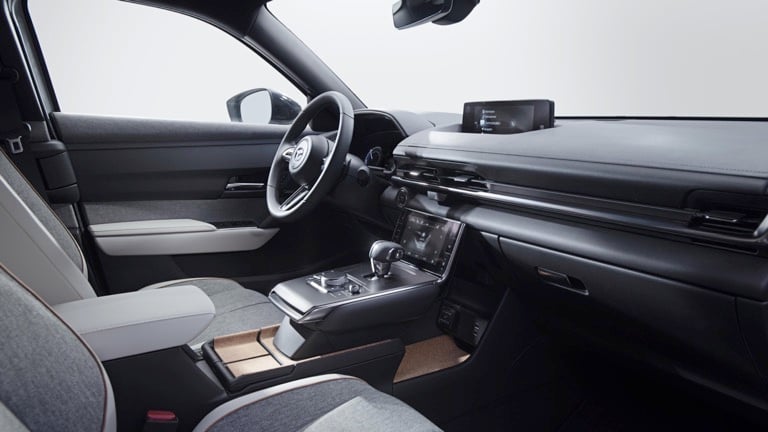
The floating centre console, which houses the gear selector and the tactile Commander Control knob, serves as a focal point in the cabin. The console is covered in traditional cork, a sustainable material that offers a unique aesthetic and recalls Mazda’s history as a producer of cork. It has a warm, matte finish that feels premium, and it differentiates itself from everything else in the industry.
All that technology in the Mazda is designed to inform and assist, not distract. The 8.8-inch infotainment display is placed high on the dash in a location easily visible to the driver. It’s not a touchscreen, unlike most rivals. Mazda has a strong belief that the very act of grabbing for a screen while you’re driving is a safety issue. Instead, you operate the system via the rotary dial on the centre console. It’s a system you quickly get acclimated to, and one that allows you to keep your gaze on the road. A second 7-inch touchscreen located further down is dedicated to climate control functions, along with physical buttons to adjust the temperature. That’s a nice ergonomic touch that ensures you don’t have to dive too deep into menus to tweak the climate in the cabin.
The Honda e: A Digital Lounge Experience
If the Mazda is a haven, the Honda e is a movie theatre. The full-width array of digital screens dominates the dashboard. Two 12.3-inch LCD touchscreens are placed side-by-side and flanked by 6-inch displays for the Side Camera Mirror System. It delivers a 360-degree panoramic digital interface that instantly makes the car stand out as a gadget enthusiast’s fantasy.
The home decor style is “California modern vintage.” The seats are covered in a melange-style sofa fabric, and the dashboard is trimmed with wood effect reminiscent of old-world furniture. The cabin floor is entirely flat, which increases the sense of space in the front, and passengers can easily slide across.
Connectivity is the Honda e’s trump card. The two displays can be used for two tasks at once, so your passenger can look for a route or music while you look at your range data. It also has an HDMI input, so you can connect a games console to play while you charge. The “Ok Honda” voice assistant allows the car to have an interactive dialogue with you, but the necessity to use touch controls for almost everything is possibly more distracting while driving than Mazda’s more tactile method.
Comfort, Ergonomics & Practicality
When it comes to comfort, the seats tell the tale. Mazda MX-30 seats. Supportive and sculpted, the seats of the Mazda MX‑30 are designed to keep the natural S-shape of your spine. With a range of seat adjustments, the driving position is commanding, as you would expect in a small SUV. Throughout the interior, recycled PET plastics are used on the door cards alongside breathable fabrics, making for a light, environmentally aware feel.
The seats of the Honda e are also flatter and softer to push the lounge feel at home, but they provide less lateral support when taking corners. The rear seat in the Honda accommodates only two people, and although the legroom is sufficient for brief trips around town, the elevated floor (thanks to the battery) can have taller passengers riding with their knees up. The MX-30 does get a bit of a break in the back, but the small windows and coupé roofline can still make it feel somewhat enclosed, creating a “cocoon” effect that some passengers find cosy, and others stifling.
Both are strong in the area of Advanced Driver Assistance Systems (ADAS). The Mazda MX-30 is equipped with the i-Activsense package, which includes Smart Brake Support and Lane-keep Assist System, which work well without being too intrusive. Honda has the Honda SENSING package, which provides similar functionality, though its Collision Mitigation Braking System does tend to be a little too sensitive in confined city traffic.
Key Takeaways: Interior & Tech
- Hear more on Tactile Ergonomics: Enjoy a safer and more intuitive interface with the rotary Commander Control knob, no longer needing to lean forward and touch the screens whilst driving.
- Cork Heritage Detailing: Create a unique, warm cabin environment using sustainable cork material that offers a premium texture and a glimpse back in time.
- Honda Panoramic Screens: Enjoy best-in-class connectivity and entertainment with a dual-screen system designed to enable passengers to interact and play games when parked.
- Digital Side Mirrors: The Honda e swaps traditional side mirrors for cameras, reducing wind noise and drag, while offering a sharp, wide-angle view of traffic in any weather.
- Comfort of Seating: Take the Mazda if you need supportive, posture-friendly seats for longer drives, or the Honda if you want a laid-back, sofa-style seating configuration for short hops.
Design & Exterior: Craftsmanship vs. Futurism
The first thing a car catches your eye on is visual; in the case of both the Mazda MX-30 and the Honda e, the statement made is strong but wildly different. The designs of the exteriors aren’t just aesthetics; they are physical representations of each brand’s philosophy. One exudes sculpted, organic shapes, the other clean, digital-age minimalism. Style & architecture unique to these city-slickers. This is where our Mazda MX-30 BEV Prime-Line Review really begins as we take a look at these two distinct design languages and architectures that make up the duo of urban EVs.
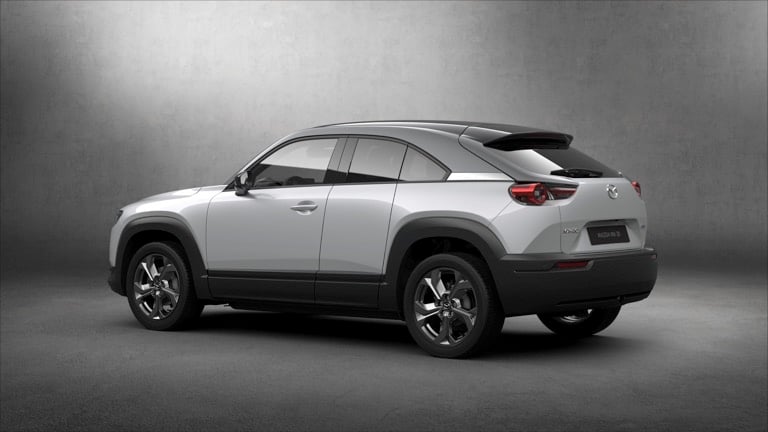
The Mazda MX-30: Kodo Design in Motion. Mazda’s design language / “kodo: soul of motion,” is aimed at embodying the energy and beauty of a living thing in motion even when the vehicle is at a standstill. MX-30 desenvolve uma interpretação mais moderna deste princípio, que a Mazda denomina “Human Modern”. It was meant to be warm and solid and beautifully simple. It shuns complicated lines and aggressive folds for clean, mirror-like finishes that toy with light and shadow. The body conveys a feeling of a uniform, solid mass, which anchors it firmly to the ground.
Exterior change: The most talked-about feature on the outside of these new models is a set of “Freestyle” doors. The wide front doors open up to 82 degrees and the rear-hinged back doors to 80 degrees. Without that central B-pillar, that means there’s a large opening into the cabin. It’s a bold architectural element inspired by the legendary Mazda RX-8 sports car and practical for loading bulky items or securing a child in a car seat. The roof design, which is coupé-inspired, gives a “sporty” feel as it slopes gracefully from the front to the rear, creating strong dynamic lines that make it different from the typical boxy SUV.
The Honda e: Retro-Futuristic Simplicity
The Honda e is inspired by and takes design cues from the original Civic, yet the friendly, simple form has been adapted for the 21st century. The look is intentionally minimal and friendly. Allwhere it applies, everything is flush, from the pop-out door handles to the charging port, located at the centre of the black bonnet panel. The result is a sleek, pebble-shaped surface, somehow at once charming and futuristic.
Among its more revolutionary styling features is the use of the Side Camera Mirror System instead of conventional wing mirrors. Small, streamlined pods with cameras attached protrude live streams to screens located inside the vehicle. This not only cuts wind noise and air resistance with an obvious percentage but also gives the car an unmistakably high-tech look. The round front and rear LED light patterns are also the same, giving the car a simple, symmetrical, and friendly “face.” The whole architecture is designed for one thing and one thing only : city living, with wheels pushed to the absolute corners. The car is packed with very little overhang, which gives the vehicle insane agility, as well as creating more space inside.
Exterior Design Comparison
|
Feature |
Mazda MX-30 BEV Prime-Line |
Honda e |
|
Colour Palette |
Features sophisticated, deep colours like Polymetal Grey and Soul Red Crystal. Offers optional three-tone paint schemes with a silver roof arch and dark grey roof. |
Focuses on modern, solid colours like Crystal Black Pearl and Platinum White, with options for a contrasting black roof to enhance the floating-roof effect. |
|
Lighting Signature |
Thin, pill-shaped LED headlights that emit a crisp, concentrated light. The taillights feature a unique three-dimensional U-shape that adds a futuristic, mechanical aesthetic. |
A combination of circular headlamps and tail lamps brings a sense of friendliness to the face and makes it instantly recognisable, almost like a character. |
|
Aerodynamics |
The sleek body, coupe roofline and sculpted surfaces have been engineered to direct air flow smoothly around the vehicle, blending style with an acceptable drag coefficient for a crossover. |
Exceptional aerodynamics for a city car, enhanced by flush surfaces, pop-out handles, and the Side Camera Mirror System that contributes to a dramatic reduction in total drag. |
|
Body Detailing |
It features strong plastic cladding around the sills and wheel arches for a more rugged, crossover look. The “MAZDA” wordmark at the rear is a bold, upscale detail. |
Minimalist detailing with an emphasis on clean surfaces. The charge port is a key design feature on the bonnet, and the black panels at the front and rear house sensors and lights. |
Key Exterior & Design Takeaways
- Freestyle Doors: The MX-30 has pillarless doors that open very wide to the front and rear, providing easier access to the vehicle and creating a unique design statement.
- Sculpted Kodo Design: Experience the brilliance of a vehicle that moves like an artwork with sweeping surfaces that interact with light and convey a sense of high-end craftsmanship.
- Camera mirror system: The Honda e’s camera mirrors, which replace traditional mirrors with slim cameras mounted on the doors, enhance visibility in adverse weather conditions and minimise wind noise, meaning the futuristic feature actually provides a real benefit.
- Urban-Centric Design: With closely spaced wheels at each corner and short overhangs, the design of the Honda e offers excellent agility to navigate tight urban streets.
- Contrasting Roof Options: Both models can be equipped with two-tone paint finishes to customise your vehicle and make its distinctive silhouette even more unique.
Safety & Reliability: Engineered for Peace of Mind
When selecting a new car, especially an electric car, safety and dependability are the top priorities. Mazda and Honda both have stout legacies of making tough, safe cars, and their pledges carry over fully in the MX-30 and the Honda e. Underneath the revolutionary styling and handling dynamics, the cars are still built with a basic intent to look after their driver and give peace of mind for many years to come. In this section of our Mazda MX-30 BEV Prime-Line Review, you will find the safety and security ratings and reliability results of the 2 variants.
Mazda MX-30: A Fortress of Safety
Mazda’s Safety Philosophy Mazda Proactive Safety MAXIMISING THE DRIVERS’ CAPABILITY TO OPERATE THE CAR SAFELY WHILE OFFERING A STRONG SAFETY NET IF THE UNAVOIDABLE HAPPENS Mazda Proactive Safety is the principle behind Mazda’s safety, which aims to balance the enhancement of the driver’s ability to operate the vehicle safely with a strong safety net if an incident comes about. This philosophy is proven by excellent results in independent safety evaluation tests of the Mazda MX-30. The car received a maximum five-star rating from Euro NCAP, with high marks for adult occupant (91 per cent) and child occupant protection (86 per cent).
A major contributor to this high rating is the extremely rigid bodyshell of the car, which was developed using Mazda’s Skyactiv-Vehicle Architecture. It is intended to absorb and disperse the impact forces from the cabin of the passengers. Mazda’s unique freestyle door system features a reinforced vertical pillar inside the rear door itself, which locks firmly into the body at the top and bottom and acts as a strong central pillar when the doors are closed. This guarantees that structural soundness is not sacrificed in the name of design. In addition to a driver’s knee airbag, the MX-30 features a full complement of airbags, including a front centre airbag, which keeps the driver and front passenger from impacting one another in a side collision. On the active safety side, the MX-30 is well-endowed with the i-Activsense series of technologies. Even in the standard Prime-Line, this comes with Turn-Across Traffic support, which can stop crashes at intersections, and Smart Brake Support with pedestrian detection. The systems are tuned to provide support without being intrusive, mitigating fatigue and increasing alertness.
Honda e: A High-Tech Guardian for the City
It’s not just the performance of the Honda e that’s impressive; the small city car also has positive safety ratings. Though it fell short of five stars, the scores it received were high, and the report praised the vehicle’s crash avoidance systems. A unique EV platform is the underscore; its battery and passenger cell are wrapped in a strong protective system.
The Honda e is equipped with Honda’s range of advanced safety and driver assist technologies, “Honda SENSING” as standard across the lineup. The full complement includes a Collision Mitigation Braking System, Lane Keeping Assist System, Adaptive Cruise Control with Low-Speed Follow, and others that have quickly become an urban driving favourite in start-stop city traffic. Road Departure Mitigation is also part of the security package, which helps steer the vehicle back into its lane if it begins to drift out of the lane without signalling. Multiple cameras and sensors that enable its more advanced features, such as the Advance model’s Parking Pilot, also enhance everyday safety by eliminating blind spots and lessening the worry of tight turns.
Reliability, Build Quality, and Warranty
Mazda and Honda are two names you can rely on for their reliability and good connotations that also apply to their electric MIVs. It feels like a very well-made Mazda MX-30. Not only are the materials used in the cabin sustainable, but they can also withstand the test of time, or at least that was the intended purpose, and the cabin doesn’t make rattling and squeaking noises. Every switch, every dial, has a crisp, tactile precision that suggests superior engineering. A standard Mazda vehicle warranty includes three years/36,000 miles for the powertrain, and the high-voltage battery is also backed by a significantly longer 8 years/100,000 miles warranty, giving long-term assurance in the powertrain.
Honda e, meanwhile, also looks well, feels solid, in keeping with Honda’s usual high standard of fit and finish. The build is solid, even with the high-tech cabin. A worry for any EV is battery degradation, and Honda, like Mazda, offers a full eight-year/100,000-mile warranty for its battery pack. This means that the battery will still have a significant amount of usable capacity for years to come. Honda’s standard vehicle warranty lasts for three years or 36,000 miles, which isn’t as generous as Mazda’s for drivers who rack up high mileage.
Key Safety & Reliability Takeaways
- Five-Star Safety: With a 91% score in adult occupant protection and a five-star rating from Euro NCAP, the Mazda MX-30 gives you class-leading crash safety assurance.
- Standard Tech With More Coverage: Both vehicles have advanced driver-assistance systems (ADAS) as standard, including automatic emergency braking and lane-keeping assist, st even on the base trim.
- Innovative Body Construction: Enjoy the MX-30’s strengthened freestyle door system, which simulates a B-pillar to provide maximum structural rigidity and occupant protection.
- Long Battery Confidence: Both Mazda and Honda offer an eight-year/100,000-mile warranty on the high-voltage batteries, protecting your investment for the long term.
- Brand Reputation: Drive with confidence, as both vehicles come from manufacturers with decades of established dependability and remarkable build quality.
Head-to-Head: The Final Verdict
When it comes to choosing between the Mazda MX-30 vs the Honda e, it’s less about which car is empirically “better” and more about which car’s philosophy better fits your life. They are both premium, design-led urban electric vehicles from well-established Japanese brands, but that’s where the similarities end. This conclusive comparison will summarise all the positives and negatives we have outlined in our Mazda MX-30 BEV Prime-Line review, giving you a clear and confident choice at the very end.
Check out our full head-to-head table below to see how these two contenders compare in the key areas of the cars.
Mazda MX-30 vs Honda e: A Side-by-Side Comparison
|
Feature |
Mazda MX-30 BEV Prime-Line |
Honda e Advance |
|
Design Philosophy |
‘Kodo: Soul of Motion’ – organic, sculpted, and grounded. A compact SUV with a coupé-like silhouette and unique freestyle doors. |
Retro-futuristic minimalism. A friendly, clean, and tech-focused city hatchback with flush surfaces and a distinct ‘face’. |
|
Performance |
145 PS & 271 Nm of torque. 0-62 mph in 9.7 seconds. Prioritises a smooth, natural, and engaging driving feel over outright speed. |
154 PS & 315 Nm of torque. 0-62 mph in 8.3 seconds. Zippy, responsive, and incredibly agile thanks to its tight turning circle. |
|
Official Range (WLTP) |
124 miles. Designed with battery “right-sizing” for lower lifecycle emissions, ideal for daily urban and suburban commutes. |
137 miles. Highly efficient for its size, offering slightly more range, optimised for pure city driving. |
|
Interior & Tech |
A driver-focused cockpit with sustainable materials like cork. Features an intuitive rotary controller for the infotainment system to minimise distraction. |
A futuristic “digital lounge” with a full-width screen array, camera mirrors, and HDMI input. Tech-forward and highly connected. |
|
Practicality & Space |
Significantly larger boot space (366 litres). The freestyle doors offer a wide opening for loading items. More of a practical daily driver. |
Limited boot space (171 litres). A strict four-seater is best suited for individuals or couples. Purely an urban mobility tool. |
|
Safety |
Five-star Euro NCAP rating. Features a highly rigid body and a comprehensive suite of i-Activsense safety aids as standard. |
Four-star Euro NCAP rating. Comes standard with the extensive Honda SENSING package of driver assistance features. |
|
Price & Value |
More accessible entry price. Offers exceptional standard equipment and build quality, representing strong value for money. |
Commands a premium for its unique design and advanced technology. Positioned as a niche, high-tech statement piece. |
Who is Each Car For?
The figures in the table give a pretty clear indication of two radically different offers.
The Mazda MX-30 is battery-electric for now, which makes it a perfect choice for the pragmatic driver moving to electric who still values some traditional automotive virtues. If you value workmanship, cosiness and a relatively quiet cabin, and a car that’s simply fun to drive, the MX-30 is for you. It’s for the purchaser who requires a degree of practicality , some boot space for the weekly shopping, or a weekend bag and regards their car as a refined sanctuary rather than a mobile gadget. It’s a practical, stylish and finely crafted take on electric mobility, with no cutting corners or hidden compromises.
The Honda e, meanwhile, is designed for the city-dwelling early adopter and tech enthusiast. If you’re a city dweller who doesn’t often make long drives and thinks of your car as part of your digital life, there’s no beating the Honda e. Its excellent handling and tiny turning circle make it a perfect fit for crowded streets, while its interior is nothing short of futuristic. For those who demand the absolute best in cutting-edge technology and iconic design, this is a striking expression.
Key Comparison Takeaways
- Practicality vs Agility: opt for the Mazda for the best boot space and the most SUV-like practicality; take the Honda for the best city manoeuvrability by a country mile 59
- Analogue vs Digital: MX-30 serves up a tactile, driver-focused experience with very few distractions, Honda e delivers an immersive, screen-centric digital experience 59
- Value vs. Premium Niche: With the high level of standard equipment that comes with the Mazda MX-30 and a more attainable price tag, this is value on steroids. The Honda e is a niche vehicle with a premium price for a niche market.
- Design Language: It will probably come down to looks: the MX-30’s slick, sculpted lines or the Honda e’s cute, retro-futuristic minimalism.
Why Choose the Mazda MX-30 or the Honda e?
Choosing between these two amazing EVs is just a matter of identity. Both are impeccable vehicles, but they cater to different priorities and sensibilities. One is a fine example of machined metal craftsmanship and the thrill of driving, and the other is an urban technology-enabled glimpse into the future of design. This last part of our Mazda MX-30 BEV Prime-Line Review will guide you in choosing the automotive philosophy that best fits you.
The Case for the Mazda MX-30 BEV Prime-Line
Opt for the Mazda MX-30 if a driving experience that is at once comfortably familiar and pleasantly refined is what you seek. It’s for the person who wants to be electrified, who wants to be electrified but still have a digitally/mechanically genius-feeling car. As a human design, MX-30 MX-30 built on human-centric principles; every detail has been engineered to deliver harmony between driver, vehicle and road. Its defining feature is the interior environment. Sustainable and distinctive materials such as traditional cork and recycled fabric are used to achieve an ambience of warmth and elegance that is beyond compare in this grade. The centre console design follows a similar philosophy, with tactile rotary controls toggling through the main infotainment options, as opposed to a distracting touchscreen. This pre-occupation with ergonomics makes the vehicle a soothing refuge in congested conditions.
In terms of practicalities, the MX-30 comes out on top by a country mile. It has a large boot (366 litres) because of its crossover design, and the driving position is more authoritative. The revolutionary freestyle doors swing wide open, providing a clean, pillar-less entry for easy loading of cargo or escorting children into the rear seats. For those buyers in need of an EV that can confidently cover daily chores, a weekly shop and occasional weekend trip, the MX-30’s greater practicality makes it the better all-round pick.
The MX-30 is for you if: You are an astute automotive enthusiast who enjoys the feel and sound of production cars and needs the practicality of a crossover for daily life.
The Case for the Honda e
We rounded up what matters most for those seeking an electric vehicle with features, city range, price, and more. Here’s a rundown of the best and worst electric cars for city driving. The Car of the Future, today, Honda e is not your regular electric vehicle; it was designed with a vision for the future, with the purpose of simplifying urban living. Empowering urban lifestyle, Tailor-made for city life, Honda e combines compact dimensions with agile handling and quick charging capabilities, empowering urban living in a new generation of electric vehicles. What more could you want? Having a rear-wheel-drive layout and a turning circle tight enough to make a U-turn from one end of Monmouth Street to the other, it waltzes along gridlocked city streets and slips into multilevel parking garages without breaking a sweat; few vehicles can match it for nimbleness.
From the dashboard to the seats, the Honda e feels like it is more from the future than simply inspired by it. The full-width digital cockpit forms the heart of the cabin, presenting a breathtaking, customizable platform for everything from navigation to entertainment. Convenience and novelty, such as the Side Camera Mirror System notwithstanding, do these new features actually improve visibility and reduce the car’s aerodynamic drag? For those with an appreciation for technology, the fact that you can multitask between screens or use an HDMI port to hook in a games console makes this car a compelling gadget even when you’re not driving.
Home, the Honda e has a tiny sweet spot of rear seat space. There’s less room for the boot, but the Honda e’s format is a textbook example of intelligent space management. Lounge-style seats and a flat floor contribute to an unexpected liveliness and communication possibility in the front cabin. It is the ideal car for individuals or couples, not families, who reside and work in urban areas and view their vehicle as a personal transport device, and not as a container for multiple passengers.
The Honda e is for you if: You live in the city, you’re tech-savvy, you love cutting-edge design and maximum urban agility, and you want a digital experience that feels just as connected.
In Summary: Your Reason to Choose
- Choose the Mazda MX-30 for…
- A superior, engaging, and natural driving experience.
- A beautifully crafted interior with unique, sustainable materials.
- Greater practicality, with significantly more boot space.
- An intuitive, non-touchscreen infotainment system that minimises distraction.
- The outstanding safety credentials of a five-star Euro NCAP rating.
- Choose the Honda e for…
- Unmatched agility and manoeuvrability in tight urban environments.
- A futuristic, screen-filled interior that feels like a digital lounge.
- Innovative technology like the Side Camera Mirror System.
- A delightful throwback to the futurefax that makes an impression anywhere.
- A quick and responsive powertrain that’s just right for weaving through urban traffic.
Choosing Your Ideal Urban EV: Mazda MX-30 vs Honda e
Choosing between the Mazda MX-30 and the Honda e is a curious moral dilemma of competing priorities in cars. They may share a similar, design-driven solution to city EV transport, but they are derived from radically different starting points. One extols the art of the drive and applied craftsmanship, the other heralds digital innovation and the agility of city living. So, as we end this comprehensive Mazda MX-30 BEV Prime-Line Review & Comparison, we should let you know this final choice is not about a simple check sheet; it’s about which car’s distinct personality speaks most to yours.
We examined two very different takes on the contemporary electric car. The all-new Mazda MX-30 is a shining example of human-centred design, its beautifully designed, warm and sustainable interior makes the perfect sanctuary. Its driving dynamics are designed to be natural and engaging, focusing on the driver’s connection to the road. With its generous boot space and adaptable crossover body style, it is the practical yet sexy solution for anyone requiring an electric vehicle to cope with the demands of a busy and diverse way of life. It demonstrates that an electric car can be green and rewarding to own and drive. Then there’s the Honda e, an audacious and endearing high-tech envoy for the future. It’s a feat of urban engineering, delivering unrivalled ability to thread through the narrowest city roadways. Its cabin is a digital lounge showcase, with a panoramic screen configuration that will excite any tech fan. The Honda e is an unapologetic statement piece, a car for the early adopter who values futuristic design and bleeding-edge features above all else. It’s the ideal partner for a life lived inside the city walls.
Making Your Final Choice
Ultimately, neither car is the “wrong” choice; they are simply the “right” choice for different people.
- The MX-30 is engineered for the style-conscious car owner who values high-quality usability and a peaceful, driver-centred appmosphere. It’s for people who want their electric car to feel like a high-quality, well-engineered vehicle first and a gadget second.
- The Honda e is aimed at the tech-savvy city dweller who desires a peppy, attention-grabbing city car that can also act as a connected device. It is for those who place value on futuristic shapes and compactness for a strictly urban life.
There are no replacements for your learning on the ground. If you want a better idea of which of these dashing electric vehicles is the best partner for your trip, we urge you to take a test drive. We suggest you arrange a test run of the two models and experience the difference for yourself. Consider what you use on a daily basis, what your style is, and what you value most in a car. You’ll know it when you find a car that both meets your needs and steals your heart.
Are you ready to locate your perfect electric mate? Reading a full Mazda MX-30 BEV Prime-Line Review could be a way to start, but the ultimate judgment is to be made on the road. Enjoy the sophisticated elegance of the Mazda and the space-age nimbleness of the Honda in person.
Schedule Your Test Drive Today and discover which exceptional EV is the right fit for you. Visit our site The.Car