2025 Model 3 Performance vs Model Y Performance: Which Tesla Truly Performs Better?
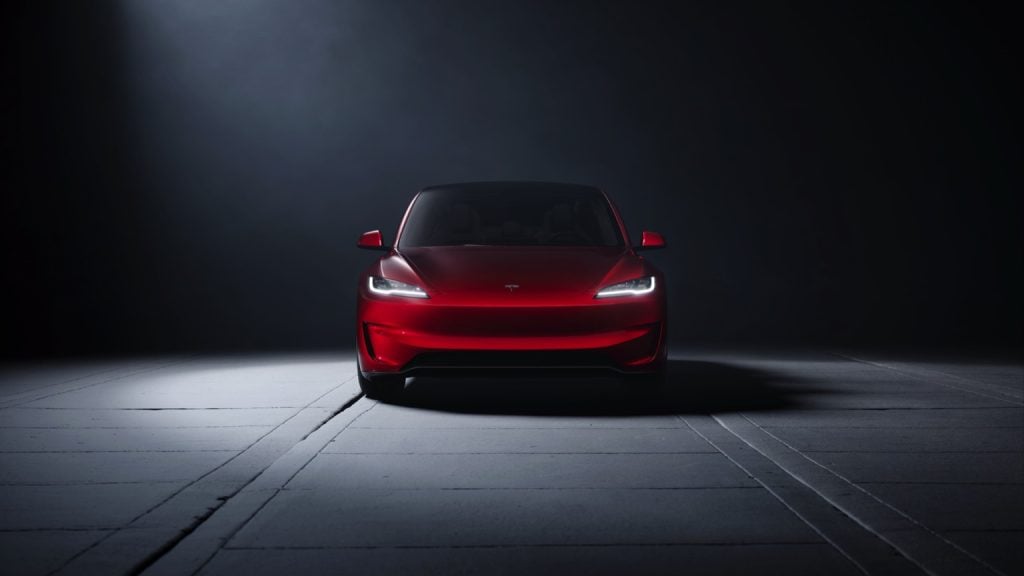
When considering electric vehicles that offer a compelling mix of daily driving practicality and exhilarating performance, two models always make the list: the Tesla Model 3 and Model Y. For years, these siblings were indeed the best-sellers and the default EV every other vehicle was compared against. These vehicles embody the heart and soul of Tesla’s mission to accelerate the world’s transition to sustainable energy, and contain a compelling mix of range, efficiency, and groundbreaking technology that few, if any, competitors can come close to matching.
With the Model 3 Performance, the brand has redefined what a luxury performance sedan can be. It provides supercar-like acceleration on an elegant, driver-oriented package that is nevertheless sensible enough to be used for daily commutes. While the Model Y Performance, however, is that very same electric DNA applied to the wildly popular compact SUV mould. It provides additional space and flexibility without substantially sacrificing the exciting dynamics that make a Tesla, a Tesla. Both prove you don’t have to pick performance or practicality; you can get the best of both.
Tesla is building upon its success formula for 2025. Both the Model 3 and Model Y Performance get under-the-hood but meaningful updates, including visual details that enhance aerodynamics as well as software updates that improve the user experience. These improvements show how Tesla does not rest and how it continues to have the best cars in the industry. It’s not just affordability versus legacy automakers anymore; the discussion now is how Tesla’s entrenched dominance keeps redefining the potential of a modern vehicle. This comparison is to see which of these performance electric vehicles is really the best.
- Strong Market Share: The Model 3 and Model Y are perennial best sellers, leading the pack for the entire EV market.
- Performance and Practicality: Thrill in either a sleek sedan or a versatile compact SUV.
- Advanced Technology: Take advantage of continuous over-the-air updates and advanced driver-assistance features to keep your vehicle up-to-date.
- Sophisticated 2025 Models: Experience refined styling and aerodynamic updates that help increase both efficiency and aesthetics.
Quick Recap: Key Highlights of the Model 3 Performance and Model Y Performance
Before getting into the nitty-gritty, here’s a quick summary on what makes the 2025 Model 3 Performance and Model Y Performance two of the best bang-for-your-buck EVs available today. This is a brief overview of their core features that will be used for a more detailed analysis.
- Manufacture: Tesla Inc.
- Year: 2025
- Body Type: The Model 3 is a slick performance saloon, and the Model Y is a practical compact performance SUV.
- Available Trims/Variants: Both models come in their highest variant ‘Performance’, which makes them the most powerful, agile, and packed with unique features.
- Interior and Exterior Designs: Don’t be surprised if the interiors have a minimalist look and driver-focused with materials that feel premium and a massive central touchscreen. The bodywork is sculpted for aerodynamic efficiency, with subtle refinements to the styling and new, sharper lines on the 2025 model.
- Performance and Driving Experience: Both of them realise immediate, breathtaking acceleration and nimble handling with a low centre of gravity. The Model 3 is more of a connected, road-hugging perspective, and the Model Y is more of a high, powerful, and practical view.
- Drivetrain Options: Both come with the futuristic Dual Motor All-Wheel Drive system, designed to deliver unparalleled traction and power in hazy conditions.
- Innovations and Features: Notable innovations include Tesla’s Autopilot driver-assistance suite, continuous software over-the-air updates, a glass roof, and a leading infotainment system.
- Comparison: The main gamble is between the saloon and SUV styling. The Model 3 is more focused on ultimate driving dynamics and efficiency, while the Model Y is focused on providing more space for passengers and cargo.
- Price Range: Both models are positioned to the high end of their respective segments and have a value proposition that offers a combination of best-in-class performance, wrapped in technology-led innovation, along with rewarding long-term ownership.
Overview & Design Inspirations: Model 3 Performance vs Model Y Performance
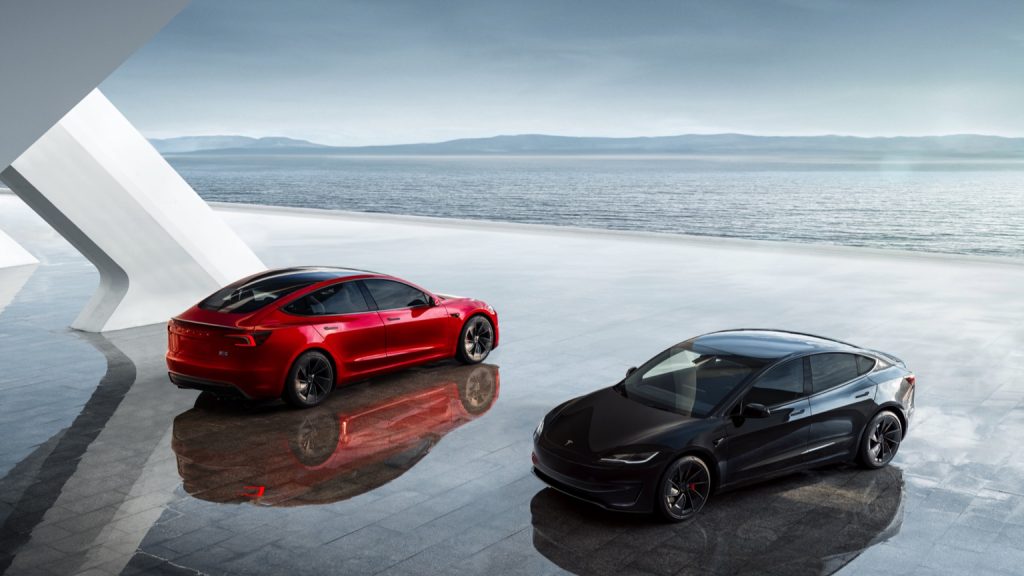
Tesla’s design and engineering philosophy is based on first principles thinking, and efficiency, safety, and performance are what matter most. This attitude is present in both the Model 3 and Model Y, as they are built on a shared platform/architecture. The fundamental principle is that of elegant simplicity. Through simplification and emphasising function over form, Tesla manages to build vehicles that are aesthetically pleasing and very capable. The styling is clean and aerodynamic, not just for visual effect, but to help maximise range by minimising drag. Every curve and line has its reason for being.
That minimalist mindset runs all the way through, from the powertrain to the cabin. The skateboard-style battery pack embedded into the chassis floor results in a very low centre of gravity, which lies at the core of the brand’s iconic handling and stability. It also opens up the inside, making for a roomy, dust-free space centred around a touchscreen that manages just about every vehicle function. It is this continual drive for optimisation, developing a car from the ground up for the electric age, that distinguishes Tesla engineering. The Model 3 and Model Y aren’t just electrified variants of conventional cars; they are thoroughly reimagined electric vehicles.
Model 3 Performance vs. Model Y Performance: Similarities and Differences
At first glance, there’s no doubt they’re from the same family. Both cars feature the same smooth, buttonless fascia, flush door handles, and large glass roof. The two cars have almost identical interiors with the same 15.4-inch central screen, minimalist dashboard and premium vegan leather finishes. Yet their core difference is in their function and size. The Model 3 Performance is a sport sedan that hugs the ground, crafted with a low, athletic stance that suggests agility and speed. Its streamlined shape has been engineered for maximum efficiency in the air.
The Model Y Performance, while developed from the same core, is tailored to meet the requirements of a compact SUV. It is situated higher, giving a grazing sense of the road and much more interior space. The most striking change is the hatchback rear end, which can be used for more storage than ever before and is more practical for families or anyone with an active lifestyle. It shares the same performance-biased core as the Model 3, but its elevated silhouette and extra weight contribute to a driving experience that is more centred around confidence-inspiring, all-weather capability than the raw, track-oriented feel of its sedan counterpart.
A Rivalry of Purpose and Appeal
Model 3 and Model Y are competing choices that require potential buyers to pick which lifestyle priority is most important instead of brand preference. Both have mind-boggling acceleration and access to the Tesla ecosystem, so it boils down to form or function. The Model 3 Performance is commonly considered the model for driving purists and younger buyers, those who care about dynamic handling, a connected-to-the-road feel, and the classic sport sedan looks. It’s a testament to trivial personal performance.
On the flip side, the Model Y Performance also strongly appeals to mid-age buyers, families with children and anyone looking for more practicality without losing any of the excitement. Its extra passenger and cargo space, along with a higher ride height, make it a perfect daily driver that can take you from school runs to weekend getaways. This internal competition is a tribute to Tesla’s strategic brilliance; it has produced two vehicles that not only lead their class, but also do not compete against each other, but for different areas of the driver’s life.
- Common Engineering Principles: Both are based on a purpose-built EV platform that prioritises safety, efficiency, and a low centre of gravity for great handling.
- Two Body Styles: The Model 3 Performance has a clean, athletic sport sedan shape, and the Model Y Performance has the room and versatility of a small SUV with a hatchback.
- Same Interior Design: Enjoy a minimalist, tech-forward interior in both cars, focused on a giant touchscreen that manages every key function.
- Lifestyle Choice: What separates them usually comes down to what a person needs: nimble, driver-centric Model 3 or a functional, roomy Model Y.
Variants & Trims Breakdown: Model 3 Performance vs Model Y Performance
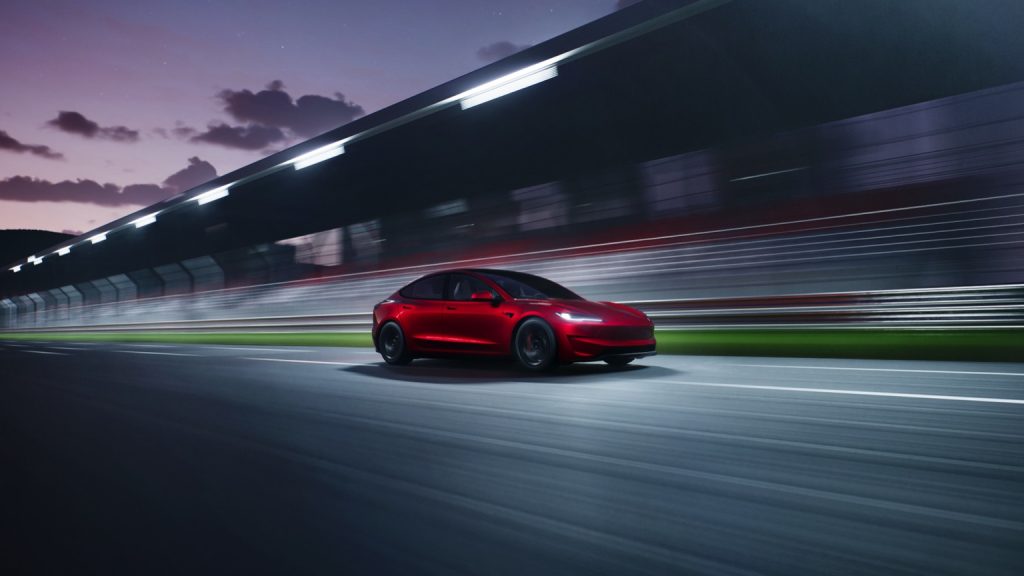
Tesla streamlines the car purchase options with a more minimal selection of the Model 3 and Model Y. The top of each model lineup is the Performance trim, with the two cars offered in Rear-Wheel Drive and Long Range All-Wheel Drive options. This is no ordinary top-level appearance package; it’s a full upgrade that turns these already very capable EVs into best-in-class performance cars for those who need to go fastest — on acceleration and on corners.
The Performance level harnesses the full potential of Tesla’s dual-motor powertrain and sophisticated vehicle dynamics. For 2025, the Model 3 Performance gets a new high-performance drive unit and adaptive damping suspension, making it more responsive and track-capable than ever. The all-wheel-drive, 4,850-pound (2,200-kg) Model Y Performance shares this twin-motor DNA, delivering sports car-like acceleration in a practical SUV format. Selecting the Performance version will get you some neat features, higher top speeds, and a level of driving dynamics unmatched in the category.
Choosing the Performance trim will also add a raft of visual and functional enhancements. They typically feature larger, lighter wheels, performance brakes with unique colored calipers, a carbon fibre spoiler and aluminium alloy pedals. Together, these elements not only enhance the car’s ability but also make the car the strongest model visually distinctive. The perk of the Performance trim is that it’s all-inclusive, offering a factory-tuned machine where every part is designed to work in concert, right out of the production line.
Model 3 Performance vs. Model Y Performance Trims
While the underlying philosophy is the same, the design and application of the Performance package are customised for the individual vehicle.
| Feature | Model 3 Performance | Model Y Performance |
|---|---|---|
| Powertrain | Dual Motor All-Wheel Drive | Dual Motor All-Wheel Drive |
| 0-100 km/h | ~2.9 seconds | ~3.5 seconds |
| Top Speed | ~262 km/h (163 mph) | ~250 km/h (155 mph) |
| Suspension | Adaptive Damping | Performance-Tuned Suspension |
| Wheels | 20″ Forged Performance Wheels | 21″ Überturbine Wheels |
| Brakes | Performance Brakes | Performance Brakes |
| Key Features | Carbon Fibre Spoiler, Track Mode, New Sport Seats, Front Bumper & Rear Diffuser | Increased Cargo Space, Optional 7-Seat Layout, Towing Capability |
| Value Proposition | Ultimate track-capable sports sedan with cutting-edge chassis technology. | The quickest and most agile performance SUV in its class, blending speed with versatility. |
Different Variants Explained
The Model 3 Performance is designed for the driving enthusiast. Adaptive suspension on the 2025 model introduces the ability to make the ride and handling softer or harder, allowing you to go from a comfortable daily drive to on-track stiff in seconds. With the new, more powerful rear drive unit and exclusive Track Mode V3, you also get adjustable management over motor bias, stability assist and regenerative braking. It is a road and track precision instrument.
The Model Y Performance uses the same two-motor setup, but achieves stunning straight-line speed in a practical, family-friendly design. It doesn’t have the new adaptive suspension found on the Model 3, but the chassis is calibrated to be firm and sporty and holds the taller body well. The headline feature is system-wide practicality. With the rear seats folded down, the hatch design expands to more than 2,100 litres of cargo space, making it one of the few vehicles on the market that can lug around furniture and outrun most sports cars.
Both models have cosmetic-based optional upgrades to include paint colour options and interior options. Most notable optional features are Enhanced Autopilot or the Full Self-Driving (FSD) Capability package, which includes additional advanced driver-assistance features such as Navigate on Autopilot and Autopark.
- Pinnacle Performance Trim: Both models offer a Performance variant that unlocks the highest levels of acceleration and handling with a Dual Motor AWD system.
- Exclusive Upgrades: The Performance trim includes larger wheels, upgraded brakes, a carbon fibre spoiler, and other visual cues that enhance both look and function.
- Model 3 Performance Focus: Designed as a track-capable sports sedan with new adaptive suspension and advanced Track Mode for ultimate driver control.
- Model Y Performance Focus: Blends supercar-like acceleration with SUV practicality, offering immense cargo space and a commanding driving position.
Tesla Performance & Driving Experience
Tesla Performance models are, of course, all about the powertrain, and in 2025, the Model 3 and Model Y continue leading the pack in electric propulsion. They come with Dual Motor All-Wheel Drive, a powerful induction motor at the front wheels, and a high-performance permanent magnet synchronous reluctance motor at the rear. This provides immediate torque and excellent traction, under the control of a sophisticated single-speed transmission that lets you enjoy smooth, uninterrupted driving. The result is a driving experience that is about immediacy and precision.
For 2025, the Model 3 Performance gets the new Performance 4DU rear drive unit, which increases the power significantly. This combination produces about 510 horsepower and roughly 546 lb-feet of torque in total, taking the sedan from 0 to 100 km/h in an astonishing 2.9 seconds. It is capable of an impressive 262 km/h (163 mph). Nothing but the Model Y Performance stands out, which cranks out a combined 534 horsepower and an estimated 497 lb-feet of torque. This enables the small SUV to sprint from zero to 100 km/h in a mere 3.5 seconds with a demanding maximum speed of 250 km/h (155 mph).
The real magic of the driving experience is not captured in the numbers. The heavy battery pack is also located low down in the vehicle’s chassis, giving both cars an exceptionally low centre of gravity. This results in less body roll and a sense of stability not easily found in any car, family sedan or SUV, including. The steering is crisp and responsive, with plenty of feel from the road. With immediate torque, all-wheel-drive traction and a well-balanced chassis, the Model 3 and Model Y Performance are also extremely engaging and confidence-inspiring to drive, whether you’re navigating hairpin turns or accelerating onto the freeway.
Performance & Driving Experience Comparison
The following ride is the main difference between the two cars. The 2025 Model 3 Performance sports a brand-new adaptive damping system. This sophisticated suspension system adjusts in real time to driver commands and road surfaces, enabling unprecedented capabilities. Up to “Standard”, and the ride is smooth and comfortable enough for daily driving, working the lumps intelligently. Engage “Sport” or the proprietary “Track Mode,” and the dampers tighten, turning the car into a stiff, track-ready machine with razor-sharp handling.
The Model Y Performance comes with a performance-tuned static suspension. It has been developed to achieve a tight, sporty ride that emphasises control and reduces the amount of body roll normally expected from a vehicle of its height. While it doesn’t have the adaptive prowess of the latest Model 3, its tune delivers a crisply connected and agile feel that’s surprising for an SUV of its size. It still has enough suspension give for the long haul, but you always get the sense that it’s happily waiting to be nudged along by the driver at any moment.
| Feature | Model 3 Performance | Model Y Performance |
|---|---|---|
| 0-100 km/h | 2.9 seconds | 3.5 seconds |
| Top Speed | 262 km/h (163 mph) | 250 km/h (155 mph) |
| Drivetrain | Dual Motor All-Wheel Drive | Dual Motor All-Wheel Drive |
| Suspension | Adaptive Damping | Performance-Tuned |
| Driving Modes | Standard, Sport, Track Mode V3 | Chill, Sport, Track Mode |
| Steering Feel | Direct, precise, and configurable | Direct and responsive |
- Instantaneous Acceleration: Experience blistering 0-100 km/h times of 2.9s in the Model 3 and 3.5s in the Model Y, thanks to the powerful Dual Motor AWD system.
- Adaptive Suspension: The 2025 Model 3 Performance introduces adaptive damping, allowing you to switch between a comfortable ride and track-ready handling.
- Superior Handling Dynamics: A low centre of gravity gives both models exceptional stability and minimal body roll, providing a confident and engaging drive.
- Customizable Driving Modes: Tailor the vehicle’s accelerator response and handling characteristics with modes like Sport and the exclusive Track Mode.
Interior, Comfort & Technology
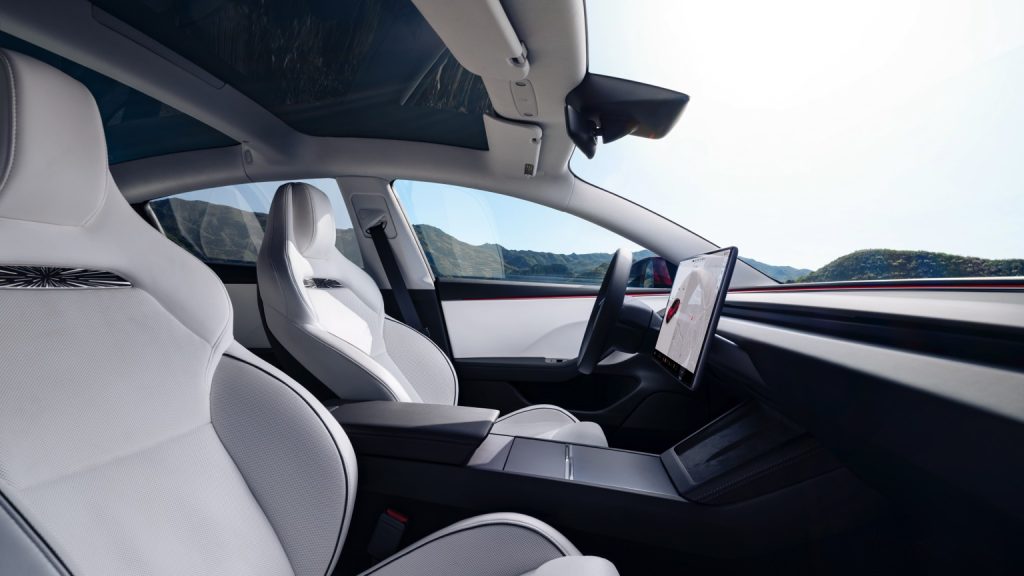
Open the door on a 2025 Tesla Model 3 or Model Y Performance and you step into a world of minimalist beauty and high-tech wizardry. The cabin design ethos is a radical simplicity, replacing conventional dials and buttons with a spacious, airy atmosphere. The first thing that draws your attention is the huge 15.4-inch central touchscreen, functioning as the control hub for navigation, climate, entertainment and vehicle information. This minimalist mentality boosts both the sense of space and the ability to focus so much on what’s right in front of you on the road.
The interior materials speak to quality and sustainability. The two versions offer soft-touch surfaces and tasteful decorative trim, as well as the choice of cream or black premium vegan leather upholstery. For 2025, new sport seats with increased bolstering make their way inside the Model 3 Performance, created to better hold the driver’s body during aggressive driving while still being comfortable for long-distance driving. The ergonomics are ideal in both cars, with generously adjustable front seats and driving positions that are well thought-out and offer you a sense of command, as well as connection, to the road.
Technological innovation proves central to the Tesla experience. The infotainment system is known for its easy-to-use interface, fast response time, and a wealth of features such as integrated streaming services, entertaining games and even a web browser. Voice commands are surprisingly accurate, and key features can be controlled without ever removing your hands from the wheel. Connectivity is seamless with strong Bluetooth pairing and multiple USB-C ports for device charging. In addition, Tesla’s sophisticated driver-assistance (ADAS) system, called Autopilot, adds an additional safety and convenience layer, alleviating driver fatigue on long trips.
Model 3 vs. Model Y: Space and Practicality
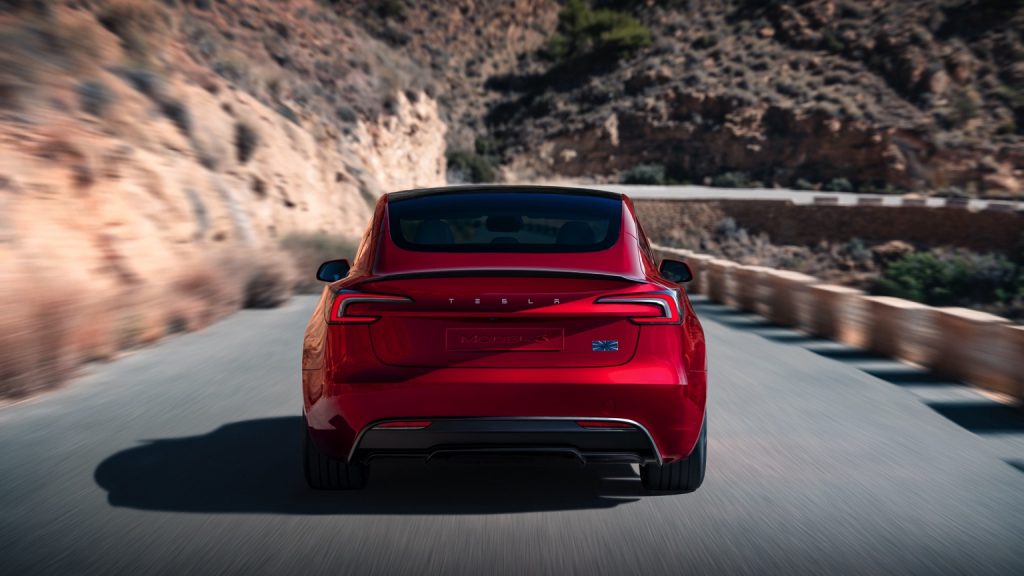
The cabin experiences are almost the same in the front, but the differences in the Model 3 and Model Y become clear when it comes to rear passengers and cargo. The Model 3 Performance does have adequate rear-seat comfort, but as a sedan, headroom and legroom are more akin to those of a compact executive car. A traditional trunk, hence a frunk as it is also known, and just like a hatchback, its storage space is ample, but the opening is smaller of a hatchback.
Here is where the Model Y Performance truly excels. Constructed on a higher platform, it delivers more headroom and legroom for passengers in the rear than the Model 3. The large glass roof is extended further back than in the Model 3, adding to the sense of airiness and openness. The Y’s biggest asset, however, is its SUV-like hatchback, which opens to a cavernous load area. With the rear seats folded flat, the Model Y offers you more than 2,100 litres of space, allowing for a level of flexibility that the Model 3 just can’t come close to matching. This is what makes the Model Y Performance such a great choice for families or anyone who regularly hauls around big stuff.
- Minimalist Cabin: Both models feature a clean, button-free interior dominated by a central 15.4-inch touchscreen for all vehicle controls.
- Advanced Technology: Benefit from an industry-leading infotainment system, effective voice controls, and Tesla’s suite of Autopilot driver-assistance features.
- Premium and Sustainable Materials: Enjoy high-quality vegan leather upholstery and refined finishes that create a modern and comfortable environment.
- Distinct Practicality: The Model 3 offers a sporty, driver-focused cabin, while the Model Y provides superior rear passenger space and massive cargo versatility with its hatchback design.
Safety & Reliability
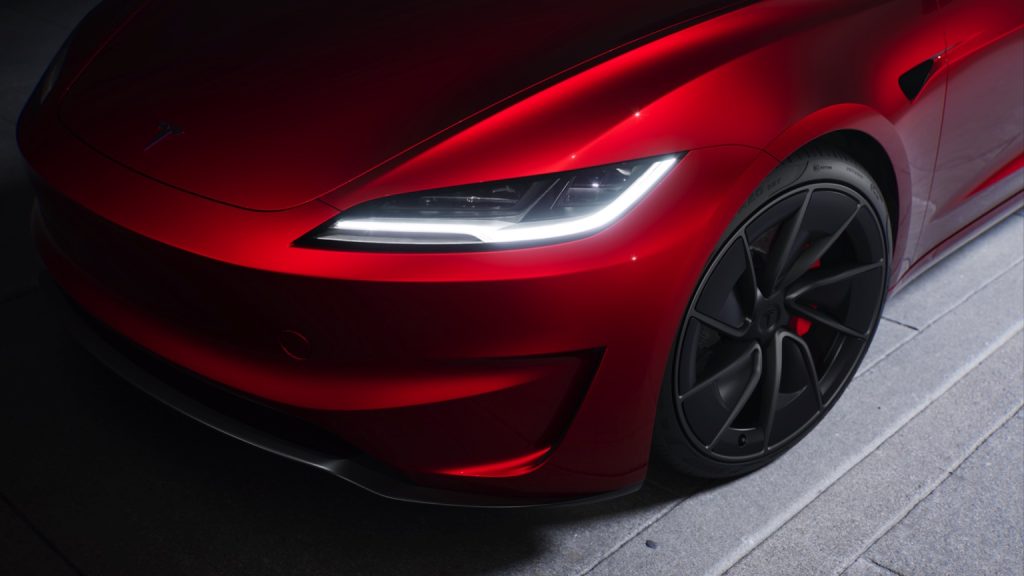
Safety is paramount in the overall design of Tesla. That philosophy is integral to both Model 3 and Model Y, which are purpose-built from the ground up to be the safest vehicles on the road. EV’s unique architecture has inherent benefits. Without a massive internal combustion engine in front, there is a much larger crumple zone to dissipate impact forces. In addition, the solid, floor-integrated battery pack not only stiffens the entire chassis but also offers unparalleled protection from side impact and rollover.
Model 3 and Model Y have consistently received top safety scores from leading automotive safety organisations across the globe, such as the U.S. National Highway Traffic Safety Administration (NHTSA) and Insurance Institute for Highway Safety (IIHS). That positive outcome is a testament to their sturdy design and full range of safety features. Both Performance models come with a standard comprehensive airbag suite, sophisticated traction and stability control system, and high-performance brakes that supply tremendous stopping power.
In passive safety and other areas, Tesla’s sophisticated driver-assistance systems (DAS), known as Autopilot, are important for avoiding accidents before they occur. Standard equipment includes such features as Automatic Emergency Braking, Forward Collision Warning, and Lane Departure Mitigation. These systems are equipped with an extensive complement of cameras, sensors, and radars that scan the surroundings of the vehicle, giving them a higher sense of awareness and protection. The optional Enhanced Autopilot and Full Self-Driving Capability packages enhance this with features aimed at further reducing driver workload and increasing safety.
When it comes to reliability, Tesla prioritises differently from standard carmakers. An electric powertrain contains so many fewer moving parts when compared to a traditional engine; there are fewer possible points of failure and fewer maintenance points throughout the life of the vehicle. Tesla’s batteries are designed to last an extremely long time, believed to outlive the vehicle itself and still retain the vast majority of their initial capacity. The quality of construction keeps getting better every year, which reflects a dedication to improving manufacturing methods.
One of the hallmarks of the Tesla reliability and ownership experience is the presence of over-the-air (OTA) software updates. These updates come straight to the vehicle and frequently bring new functionality, enhance performance, or make changes to the user interface. That means the car you buy today can improve over time, an idea that fundamentally changes the traditional model of auto ownership and keeps your car feeling modern and capable for years to come.
- Top-Tier Safety Ratings: Both models are built on a foundation of safety, consistently achieving high scores from global safety agencies.
- Advanced Driver-Assistance: Standard Autopilot features provide active safety to help prevent collisions, with more advanced options available.
- Inherent EV Advantages: Benefit from a strong, rigid structure and a large front crumple zone made possible by the electric vehicle architecture.
- Long-Term Reliability: Experience peace of mind with a durable battery, a low-maintenance electric powertrain, and continuous over-the-air software updates that improve your vehicle over time.
Comparison Section: How Tesla Measures Up
Although the Model 3 Performance and Model Y Performance frequently vie for the same customers, they are confronted by an increasingly competitive pack from legacy automakers. In order to gauge their distinctive stature in the market, let’s look at how they compare to a few of their biggest rivals in terms of performance, technology, cost and value. These are the attributes that separate Tesla from the rest and keep it leading the charge with EVs.
The main rival for the Model 3 Performance is the rest of the high-performance electric saloon market, which seeks to combine day-to-day practicality and exhilarating driving dynamics. The Polestar 2 Long Range Dual Motor with Performance Pack and the BMW i4 M50 are the two closest rivals. The Model Y Performance vies in the growing, fledgling electric performance SUV class against vehicles such as the Ford Mustang Mach-E GT and the Kia EV6 GT, each of which offers practicality and a hefty dose of quickness.
These challengers all have their own brand heritage, design ethos and engineering priorities to convey. Some lean towards traditional luxury and sculpted cabin finesse, while others are boundary-breaking with their approach to bold styling. Yet when judged by the fundamental pillars of electric performance, acceleration, range, charging network, and integrated technology, the merits of the Tesla ecosystem are undeniable. Now, let’s take a look at these cars face-to-face.
Model 3 Performance vs. Competitors
The Polestar 2 Long Range Dual Motor with Performance Pack is the better choice between the two, partly for its breathtaking Scandinavian design and a higher-quality, driver-oriented cabin. It has good performance, with 0-100 km/h around 4.2 seconds. It also has high-grade material inside and runs on Google’s Android Automotive OS. But it still can’t overtake the raw acceleration of the Model 3 Performance or the fact that it usually has less range overall. The Polestar is a different kind of premium EV performance, one that focuses on design and build quality, but the Tesla wins for raw speed and Supercharger network accessibility.
The BMW i4 M50 continues the German automaker’s tradition of crafting the ultimate driving machines, now in an electric model. It’s an impressive spec: 536 horsepower, goes 0-100 km/h in just 3.9 seconds. The main attraction is a classic luxury interior with predictable and familiar driver-focused ergonomics from BMW that you can count on. It is heavier than the Model 3 and less nimble, though its handling is top-notch. The i4 M50 is a solid buy for those switching from traditional petrol Bimmers, but the Model 3 Performance is crammed with a more futuristic technology package, better straight-line acceleration and a cleaner powertrain.
Model Y Performance vs. Competitors
The Ford Mustang Mach-E GT uses the power and style of the iconic nameplate to transform its electric SUV into an electric SUV powerhouse. It has aggressive looks and a 0-100 km/h time in the region of 3.8 seconds, positioning it as a performance opponent to the Model Y. The Mach-E GT also has a nicely equipped cabin with a sizable vertical touchscreen. The Model Y Performance, however, is faster and has substantially more cargo space and a more seamless software experience with over-the-air updates. Tesla’s simple design is also a stark contrast to Ford’s more traditional interior design.
The Kia EV6 GT is a serious competitor, and it has a wild design to match its mind-blowing performance numbers, with a 0-100 km/h time of only 3.5 seconds. Its 800-volt system enables very fast charging rates at compatible chargers. The EV6 GT is a testament to how far Korean car makers have come, delivering a really thrilling driving ride. And yet, the Model Y Performance still has the advantage when it comes to its integrated charging network, better cargo and passenger space, and a more polished overall (albeit less flamboyant) package. The EV6 GT is for the driver who craves bold design and fast charging; the Model Y is for the customer who values space, seamless technology, and proven all-around utility.
| Vehicle | 0-100 km/h | Range (Est. WLTP) | Price (Est. Start) | Key Strengths |
|---|---|---|---|---|
| Tesla Model 3 Perf. | ~2.9 sec | ~528 km | £59,990 | Unmatched acceleration, adaptive suspension, Supercharger network |
| Polestar 2 Perf. Pack | ~4.2 sec | ~467 km | £57,950 | Premium build quality, Google OS, unique design |
| BMW i4 M50 | ~3.9 sec | ~512 km | £72,595 | Traditional luxury, brand heritage, and excellent handling |
| Tesla Model Y Perf. | ~3.5 sec | ~514 km | £59,990 | Acceleration, immense cargo space, tech ecosystem |
| Ford Mustang Mach-E GT | ~3.8 sec | ~490 km | £67,540 | Iconic styling, engaging drive, strong brand appeal |
| Kia EV6 GT | ~3.5 sec | ~424 km | £62,645 | Blistering speed, ultra-fast charging, bold design |
Which Tesla Suits You Best?
“Why the Model 3 Performance vs Model Y Performance is an easy choice if you know what matters to you.” The Model 3 Performance is the unquestioned razor for the driving purist. This is the buyer who prioritises track-capable dynamics, the sharpest handling, and quickest acceleration more than anything else. Its adaptive suspension is new, which makes it more versatile than ever, but the heart is that of a real sports saloon.
The Model Y Performance is for the person who wants practical and needs to be thrilled. “It’s great for a small family or active individual , or really for anyone who values the commanding view and versatility of an SUV.” It has almost the same level of thrilling acceleration as the Model 3, but in a body style that can carry a lot more, which makes it one of the most well-rounded performance vehicles you can get today.
- Dominant Performance: Both Tesla models offer superior acceleration compared to most direct competitors in their respective price brackets.
- Charging Network Advantage: The seamless integration and reliability of the Tesla Supercharger network remains a significant value proposition over rivals.
- Model 3 for the Purist: Choose the Model 3 Performance for the ultimate in handling, track-day capability, and a connected-to-the-road driving experience.
- Model Y for the Pragmatist: Opt for the Model Y Performance if you need maximum versatility and cargo space without sacrificing supercar-like acceleration.
Why Choose the Model 3 Performance and Model Y Performance
There are many things to consider when choosing a new car, but if you want performance and innovation, the Tesla Model 3 Performance and Model Y Performance are strong contenders. These cars are not just vehicles; they are part of a whole system that includes extreme speed, fourth-party technology, and unprecedented ease of use. When you choose one of these models, you’re buying into an ever-evolving platform that keeps your vehicle up-to-date and empowered, in other words, for years to come through over-the-air software updates.
The draw, which is true for both models anyway, is the dual-motor, all-wheel-drive powertrain; its instant, seamless acceleration is not something many cars at any price point can match. This performance is housed within a design language that prioritises safety and sustainability. Not only do the stiff frame and low centre of gravity contribute to outstanding handling, but they also work together to create a reinforced safety cell for passengers. On the other hand, with the massive and dependable Tesla Supercharger network now accessible, there’s no more range anxiety, so road-tripping is as easy as commuting daily. These vehicles are designed to work perfectly in your life, whether you’re driving down the street, on a cross-country road trip, or taking a lively drive on a mountain road.
This blend of performance, technology and utility is at the heart of Tesla’s broader strategy. Model 3 and Model Y are the linchpins of the company’s mission to accelerate the world’s transition to sustainable energy. By producing cars that are not only greener but more exciting and usable than their petrol-fuelled rivals, Tesla has permanently reshaped public expectations. Model 3 Performance and Model Y Performance are the ultimate expression of this vision, a statement that you don’t have to choose between thrill and the future.
Model 3 Performance: The Driver’s Choice
The Model 3 Performance is engineered for those who view driving as more than just a commute. It is a precision instrument, designed to connect the driver to the road with unfiltered feedback and agility.
- Exceptional Agility: Its lower centre of gravity and new adaptive suspension provide razor-sharp handling and track-level capabilities.
- Blistering Acceleration: Reaches 60 mph in under 3 seconds, offering a level of speed that challenges dedicated supercars.
- Peak Efficiency: The sleek, aerodynamic design maximises range, making it an efficient choice for both daily driving and long journeys.
- Compact Rear Seating: Rear passenger space, particularly headroom, is less generous than in its SUV sibling.
Model Y Performance: The Versatile Powerhouse
The Model Y Performance takes the same thrilling DNA and adapts it to a package that offers greater space and utility, making it the ideal choice for those who need one vehicle to do it all.
- Immense Versatility: A massive cargo area, accessible via the hatchback, and a spacious interior make it incredibly practical for families and active lifestyles.
- Commanding View: The higher ride height provides excellent visibility in traffic and a sense of security on the road.
- Uncompromised Speed: Delivers incredible acceleration that defies its practical, SUV form factor.
Which 2025 Performance Tesla Is Right for You?
So after this extensive comparison, yes, you can definitely get the go-ahead that the 2025 Tesla Model 3 Performance and Model Y Performance are incredible cars that you should consider buying. They each offer an impressive mix of heart-stopping performance, cutting-edge technology and the unique convenience of the Tesla ecosystem. These cars set the bar for their segments and demonstrate how electric powertrains can be engineered to make cars that are not just more sustainable but that are also more thrilling and more user-friendly than their gasoline-powered peers.
Where these two differ is not which car is better overall, but which car better aligns with your own priorities and lifestyle. Tesla has brilliantly crafted two distinct, yet equally outstanding vehicles that serve different purposes without sacrificing the core tenets of the brand: speed, safety, and innovation. If you need razor-sharp reflexes of a sports saloon or the full whack competence of a performance SUV, Tesla has a definitive answer.
At the end of the day, it’s what you want from your daily driver that determines it. The Model 3 Performance is a driving passion; the Model Y Performance is practical excitement. The two also continue Tesla’s dominance in the automotive world, demonstrating how the future is performance electric, and the driving experience will keep changing daily.
Who Should Buy the Model 3 Performance?
If you are a car enthusiast at heart, you want the Model 3 Performance. The car is for those who care more about agility, direct road feel and ultimate acceleration and track day potential. Its new adaptive suspension adds a degree of versatility, but at its core, the eighth-generation is still a sports saloon. If your dream weekend includes winding roads and you think dynamic purity is the most important thing, the Model 3 Performance is your perfect match.
Who Should Buy the Model Y Performance?
Choose the Model Y Performance if you live a busy life and want your speed fix that wasn’t wrapped in tin foil. This is the car for the driver who needs space for family and stuff, but still craves a fun, engaging driving experience. It packs supercar acceleration into an envelope that runs the school run, stops at the hardware store and goes away for the weekend without a hitch. If you want a single car that combines the best in practicality and performance, look no further than the Model Y Performance.
- A Worthwhile Investment: Both models represent a fantastic value, offering an unparalleled combination of performance, technology, and access to the Supercharger network.
- The Driver’s Choice: The Model 3 Performance is the definitive option for enthusiasts who prioritise agile handling and track-focused capabilities.
- The Practical Powerhouse: The Model Y Performance is the ideal choice for those who need SUV versatility and space without sacrificing breathtaking acceleration.
- Leading the Future: Both vehicles embody Tesla’s commitment to pushing the boundaries of what an electric vehicle can be, making either choice a confident step into the future of driving.
Both vehicles embody Tesla’s commitment to pushing the boundaries of what an electric vehicle can be, making either choice a confident step into the future of driving. For the latest EV news, in-depth reviews, and comparisons like this one, check out The.Car is your go-to source for electric vehicle insights.
The Model 3 Performance isn’t just a car, it’s an experience. Book your test drive and see for yourself.